

Tech overview
Stable's transaction pipeline has four layers: consensus, execution, storage, and RPC. You can use standard EVM tooling while Stable-specific subsystems handle finality, USDT0 gas, state access, and transaction throughput.
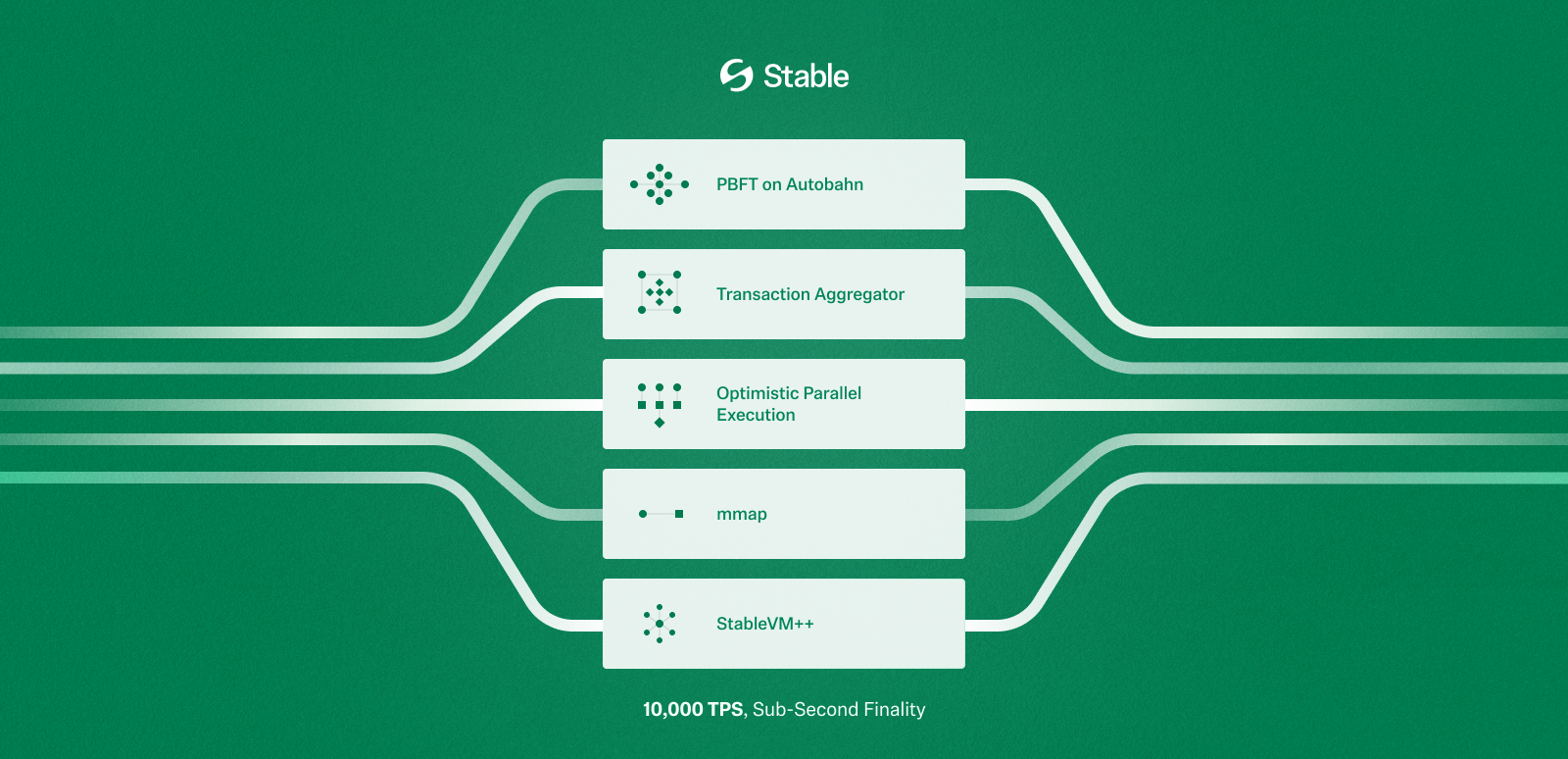
StableBFT
Status: LiveStable Blockchain leverages StableBFT, a customized PoS consensus protocol built on CometBFT, for high throughput, low latency, and strong reliability across the network.
Stable EVM
Status: LiveStable EVM is Stable's Ethereum-compatible execution layer. Standard Ethereum tools and wallets interact with the chain unchanged. A set of precompiles bridges Stable EVM to the Stable SDK, letting EVM smart contracts call into core chain logic atomically.
StableVM++, a possible replacement for the current Go-based EVM implementation, remains a later roadmap item.
StableDB
Status: Live on Mainnet in v1.8.0MemIAVL replaces LevelDB with a memory-mapped snapshot and an append-only write-ahead log. A RocksDB-backed VersionDB serves historical queries older than the retained snapshots.
High performance RPC
Status: LiveA slow RPC layer ruins the user experience even on a fast chain. Stable addresses this with a split-path architecture that separates operations by function, deploying lightweight, specialized RPC nodes for faster response times.
Where to go next
- Execution: Understand how OPE and Selective RecheckTx remove CPU bottlenecks.
- Storage (StableDB): See how MemIAVL changes current and historical state storage.
- Guaranteed blockspace: Understand the 2D nonce and block-lane model.
- Network upgrades: Review v1.8.0 compatibility and activation details.